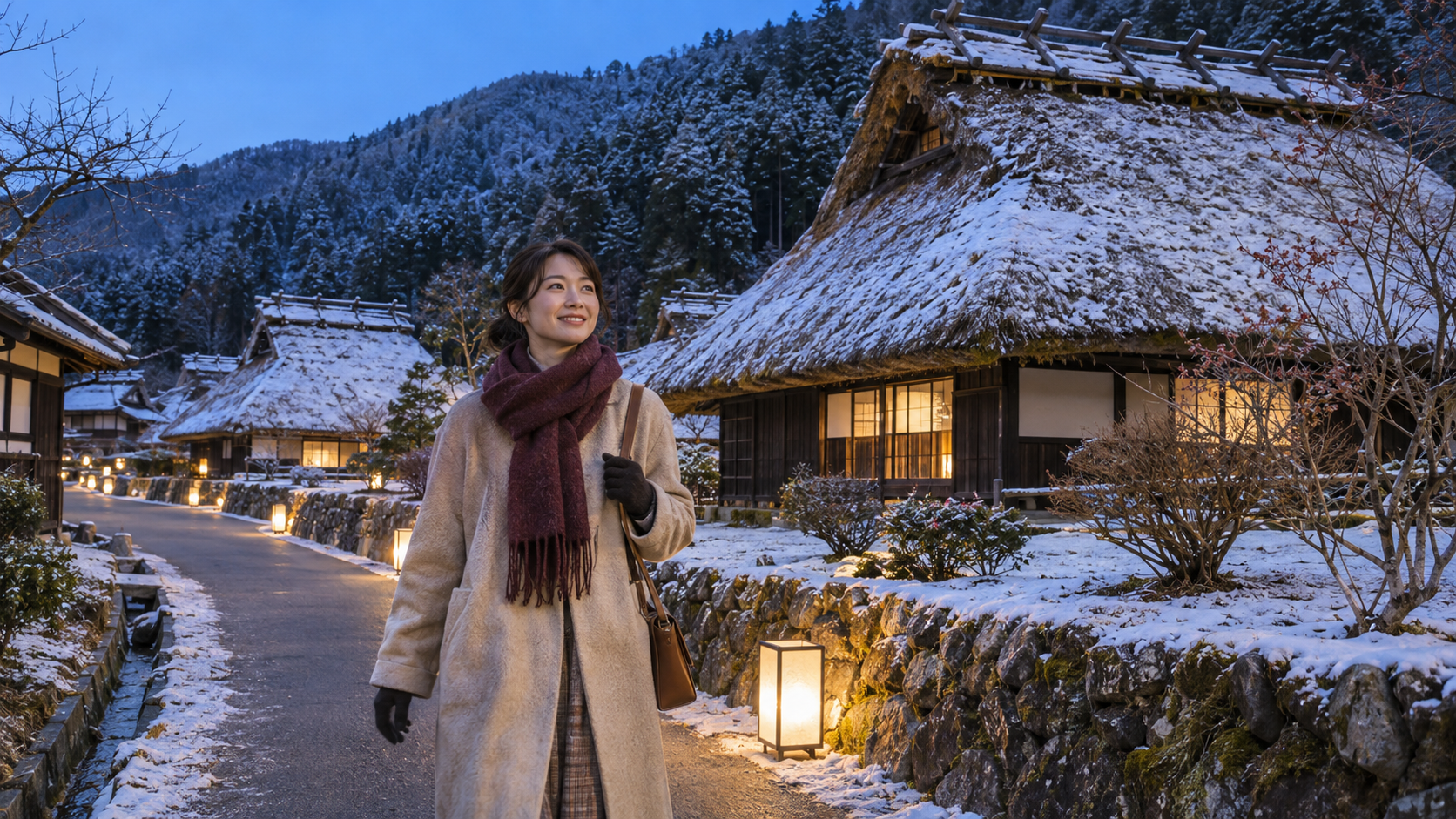
Miyama renamed its Snow Lantern Festival in 2026 as snowfall declined, keeping the winter lights even when snow is scarce.
Miyama Winter Lantern Festival takes place from January 30 to February 6, 2027, in Kayabuki-no-Sato, a thatched-roof village in Nantan City, Kyoto Prefecture. The official festival site (opens in a new tab) confirms eight evenings of illumination, daily from 5:00 to 7:00 p.m. The rural village is north of central Kyoto; plan the return journey before you arrive, especially if you want to stay until the lights go out.
What to see in the village
During the festival, lanterns along the paths and lights on the thatched houses illuminate Kayabuki-no-Sato after dark. The 2027 event program (opens in a new tab) describes approximately 80 street lanterns, 200 LED lanterns and around 20 illuminated houses. Food stalls are scheduled from 3:00 to 7:00 p.m. each day, giving visitors time to eat before or during the illumination.
Kayabuki-no-Sato is a residential community. Many of its thatched houses are private homes. Stay on public paths, keep voices low in the evening and do not enter gardens or buildings without permission. The organizers also prohibit drone flights in and around the village. These rules protect the residents' privacy.
Why the festival changed its name
The event was previously known as the Snow Lantern Festival. According to its organizers (opens in a new tab), residents began lighting snow lanterns to welcome winter visitors, but declining snowfall led to the name Winter Lantern Festival from 2026. The lights now include LEDs and street lanterns, so the festival does not depend on a blanket of snow for its main illumination.
Snow is possible in winter, but it is not guaranteed for any particular evening. The festival FAQ (opens in a new tab) says the event normally proceeds even without snow, though dangerous weather can lead to cancellation. Check the latest announcement and snow conditions before leaving Kyoto.
Mochi, zenzai and a February 3 performance
The 2027 program includes a mochi-pounding activity at Chii Hachiman Shrine, followed by zenzai, a sweet red bean soup with rice cake. The official schedule lists it from 5:15 to 6:15 p.m. on most days, with an earlier session from 5:00 to 5:45 p.m. on February 3. Participation is limited and available on a first-come basis. The listed fee is ¥300 per person, or ¥500 on February 3, when the activity is linked to the dance program; payment is in cash.
A traditional Japanese dance dedication at the shrine is scheduled for February 3, 2027, from 5:45 to 6:05 p.m. The organizers list a ¥500 ticket including the mochi activity. Check the official event page (opens in a new tab) for capacity, availability and any changes. The organizers state that there will be no fireworks in 2027.
Tickets, parking and cash
There is no admission fee for the festival, according to the official FAQ (opens in a new tab). Parking and some activities have separate charges. The FAQ says food stalls take cash and there is no nearby ATM, so bring enough yen before arriving rather than relying on a card or a cash machine in the village.
Advance parking reservations are required for vehicles during the festival, including taxis using the event parking area for drop-off. The published event fee for a standard car, taxi or van is ¥1,500 per vehicle. Spaces are limited, and the organizers say there is no alternative parking nearby. Reserve through the official access page (opens in a new tab) and check the current entry times and conditions before traveling. Winter tires are required for the drive.
Getting there from Kyoto
One public-transport route is to take a JR train to Hiyoshi Station and then a Nantan City bus to the Kita stop. Services are limited, and the festival access page (opens in a new tab) lists different last departures depending on the day. Some leave before the 7:00 p.m. end of the illumination. Check the current timetable for your exact date and arrange your return before setting out.
The regular Kyoto–Miyama Line excursion bus will not operate in 2027. The organizers point visitors to a separately booked tour from JR Kyoto Station offered by the Kyoto Miyama Tourism Association. An overnight stay in Miyama or a car with reserved parking are other options; confirm your onward transport with your accommodation or provider. Do not assume an old shuttle timetable applies to this edition.
Where to stay and what to bring
Miyama's thatched village is a designated historic preservation district. The local tourism office (opens in a new tab) explains that the village was designated in 1993 and that its folklore museum offers a look inside a traditional farmhouse. Check the museum's current opening days separately if you plan a daytime visit.
A stay in or near Miyama can make the evening easier to plan, while Kyoto offers a wider base for travelers arranging a tour. Compare accommodation around Nantan (opens in a new tab), confirm the distance to the village and ask how to get back after the lights. Bring warm layers and footwear suitable for icy or snowy paths. Watch for uncovered roadside irrigation channels, which may be difficult to see after dark or under snow.
Public holidays around the festival
Public and bank holidays in Japan from 3 days before to 3 days after the festival ().
Shops, banks and transport should keep their normal timetable.
Editions
- 2027In 86 days